
There is a familiar moment in the life of a critical financial platform when a full rewrite starts to look attractive.
The platform is difficult to change. Releases take too much effort. Integration points have accumulated over many years. Product rules live across workflows, database procedures, services, configuration, operational scripts and manual workarounds. Everyone knows there is technical debt. Everyone also knows that the system still runs the business.
A clean replacement seems to offer a way out. New technology. Clearer ownership. Better deployment. More understandable integration. A platform that is easier to support, easier to explain and easier to change.
The hard part is that live financial platforms carry more than code. They carry years of business policy, product variation, operational exception handling, regulatory interpretation, third-party behaviour, reconciliation logic and customer-facing edge cases. Much of that knowledge is only partly documented. Some of it becomes visible only when something fails in production.
For that reason, modernization should start with a different question.
Instead of asking, "How do we replace this system?", the better question is: "How do we reduce the risk of changing this platform while the business continues to depend on it?"
That distinction matters. For critical financial platforms, modernization is a delivery and risk strategy before it is a technology replacement exercise.
Why full rewrites are attractive on paper
The appeal of a full rewrite is understandable.
The current platform may be old, expensive to support and difficult to staff. It may depend on frameworks, deployment models or integration styles that no longer fit the organisation. It may slow down product change, make onboarding difficult and create too much regression risk for changes that look small from the outside.
A new platform appears to offer clarity. Teams can design a cleaner domain model, use current engineering practices, remove obsolete behaviour and avoid years of accumulated compromise. Leadership can fund a programme with a visible target state rather than a long sequence of improvements to an old estate.
Sometimes replacement is the right decision. A small, isolated system with limited live obligations may be cheaper to rebuild than to preserve. A product nearing retirement may not justify years of careful displacement. A platform that no longer matches the future business may deserve a deliberate exit plan rather than continuous extension.
Most critical financial platforms sit in a harder category.
They are connected to active products, customers, brokers, operational teams, third-party providers, historic data, reporting processes and control obligations. A cleaner replacement may still be desirable, but the organisation rarely has the luxury of switching from one world to another in a single controlled step.
The new system has to reproduce behaviour that still matters. It has to integrate with current providers. It has to support ongoing product, policy and regulatory change. It has to preserve data integrity. It has to support operations. It has to run alongside the old system long enough to prove that it works. The business continues to originate loans, service accounts, make decisions, generate documents, process payments, report positions, manage exceptions and support customers while all of this is happening.
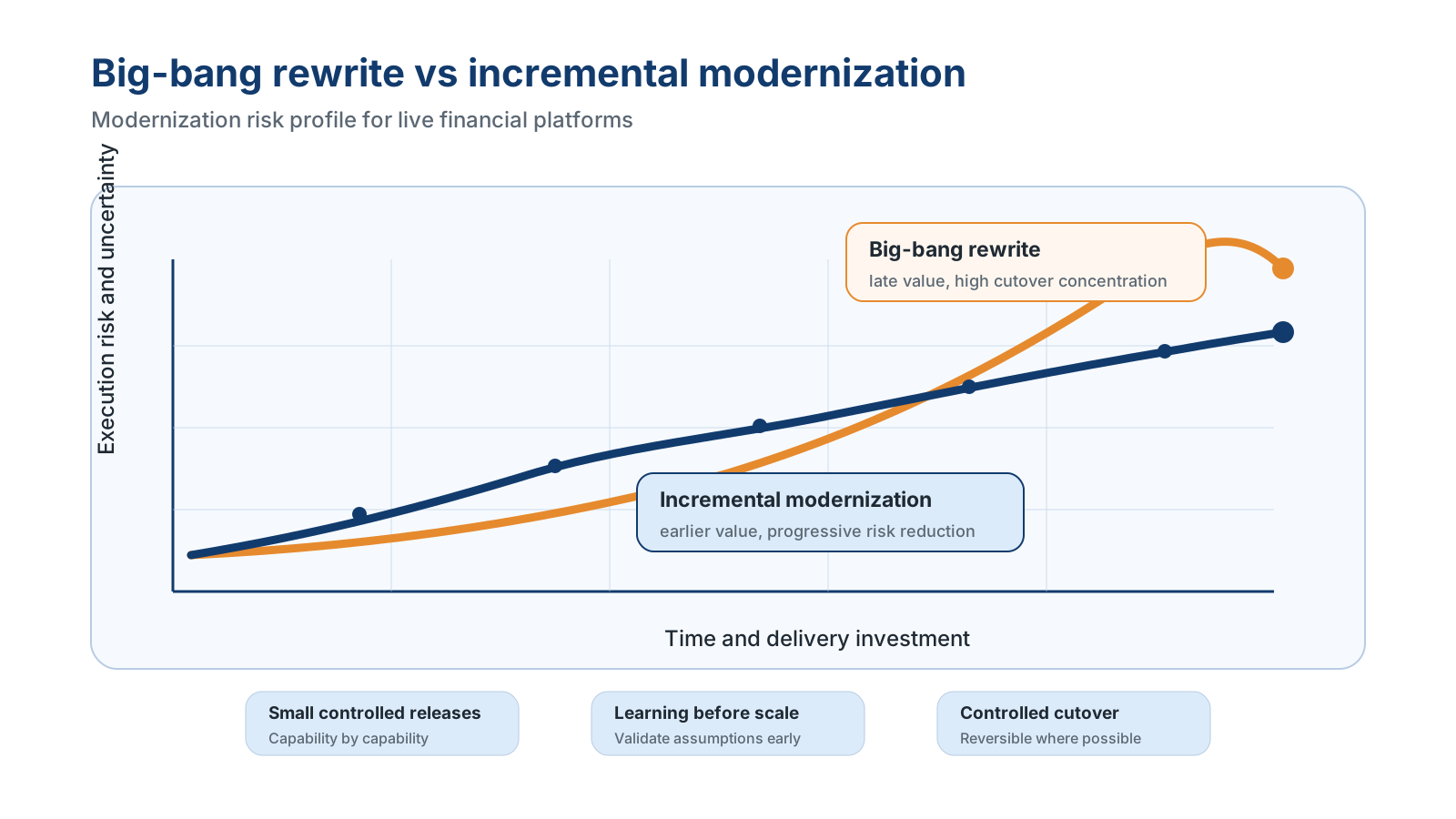
That is where rewrite programmes become difficult. The old platform continues to change while the new one is being built. Product teams still need delivery. Operations still need fixes. Providers still change APIs, schemas, credentials, certificates and reporting formats. Policy and regulatory changes continue. The rewrite starts to chase a moving target.
The organisation then pays for two platforms: the one that runs the business and the one that is supposed to replace it. The longer this continues, the harder it becomes to keep both worlds aligned.
Cost overrun is only one risk. The deeper risk is delayed value combined with rising uncertainty. Data migration remains unresolved. Operational readiness is deferred. Reconciliation is treated as late-stage testing. Domain knowledge leaves the organisation. Cutover becomes a business event rather than a controlled technical release.
Incremental displacement changes that risk profile. It does not make replacement easy. It allows the organisation to test assumptions earlier, release value sooner, contain failure blast radius and learn before the most sensitive parts of the platform are moved.
That difference is often decisive.
Why financial platforms are different
A mature financial platform sits inside the operating model of the business.
In lending, mortgages, savings, banking, payments and fintech, the platform often supports eligibility, affordability, credit decisioning, bureau integrations, fraud checks, KYC, pricing, document generation, broker and customer journeys, servicing, arrears, payments, reporting, complaints, operational queues and audit evidence.
Those capabilities rarely behave like isolated technical functions. Some run in real time. Some run in batch. Some depend on third-party providers. Some involve manual operations. Some are visible to customers, brokers or intermediaries. Others appear only during exceptions, remediation work, back-book servicing or regulatory reporting.
The platform also holds financial and operational data that has to remain consistent across the customer lifecycle. A wrong decision, missing document, duplicated payment, failed reconciliation, delayed redemption statement, broken account access journey or incorrect arrears status can create real consequences. It may look small on an architecture diagram and still lead to customer harm, remediation cost, production incidents and loss of confidence.
Operational resilience has become more visible at board and executive level across financial markets for the same reason. The exact regulatory language differs between jurisdictions, but the underlying concern is consistent: important financial services must remain understandable, controlled and recoverable when technology changes, suppliers fail or operational disruption occurs.
In the European Union, DORA has made ICT risk, digital operational resilience and critical third-party technology dependency more explicit across the financial sector. International bodies such as the Financial Stability Board and the Basel Committee also frame resilience and third-party dependency as issues that cross firms, sectors and jurisdictions. For organisations operating in UK, EU, the Middle East or other international markets, the practical engineering question is similar even when the rulebook differs: can the firm understand how important services depend on systems, data, people, suppliers and recovery processes?
These expectations should not turn modernization into a compliance exercise. They reinforce a delivery reality. A cleaner architecture is not enough if the business cannot explain how the platform behaves, how failures are handled, how data remains consistent and how critical services continue to operate during change.
External dependencies quickly become part of the modernization risk. Credit bureaus, valuation services, payment providers, open banking platforms, identity services, document platforms, notification gateways, cloud providers and core banking integrations may all sit in the path of a single customer journey.
A realistic modernization plan accounts for those dependencies from the start. It needs to understand contract constraints, test-data limitations, incident communication, audit evidence, exit options, concentration risk, subcontractor visibility and operational runbooks. Otherwise the new architecture may look cleaner while the business remains exposed to the same external failure modes.
Incremental modernization is usually safer
Incremental modernization means changing the architecture in controlled steps while the business continues to operate.
The aim is to reduce execution risk by observing and learning early, proving assumptions and releasing value before the whole programme is complete. Instead of betting everything on a future replacement, the organization gradually changes the shape of the platform around real business capability boundaries.
This is important because legacy platforms rarely reveal all complexity during discovery. Teams learn by touching the system, tracing data flows, comparing outputs, handling production-like cases, testing failure modes and seeing how operational teams actually use the platform.
This incremental approach allows to influence the next step. It also allows leadership to see progress earlier: fewer changes requiring risky core modification, better integration control, clearer operational diagnostics, easier reporting extraction, or a document boundary that can now evolve independently.
The approach has a cost. Wrappers, adapters, temporary data flows, reconciliation processes and duplicate running all need design, support and retirement plans. The organization should be explicit about the cost of that risk mitigation.
That is a mature conversation to have. The alternative is often worse: pretending that a rewrite is simpler because the complexity is not yet visible.
Start with capability boundaries, not technology
One of the most common modernization mistakes is to start with technology selection.
Questions about microservices, event streaming, cloud-native services, workflow engines, new databases or API gateways may be valid later. They become dangerous when they are used as substitutes for understanding the business capability being changed.
The better starting point is capability.
What does the platform actually do? Which capabilities change often? Which are stable? Which create the highest operational risk? Which depend on third parties? Which have clear inputs and outputs? Which have strong reconciliation paths? Which have weak ownership? Which are tightly coupled through shared data? Which look complicated only because they sit inside the wrong boundary?
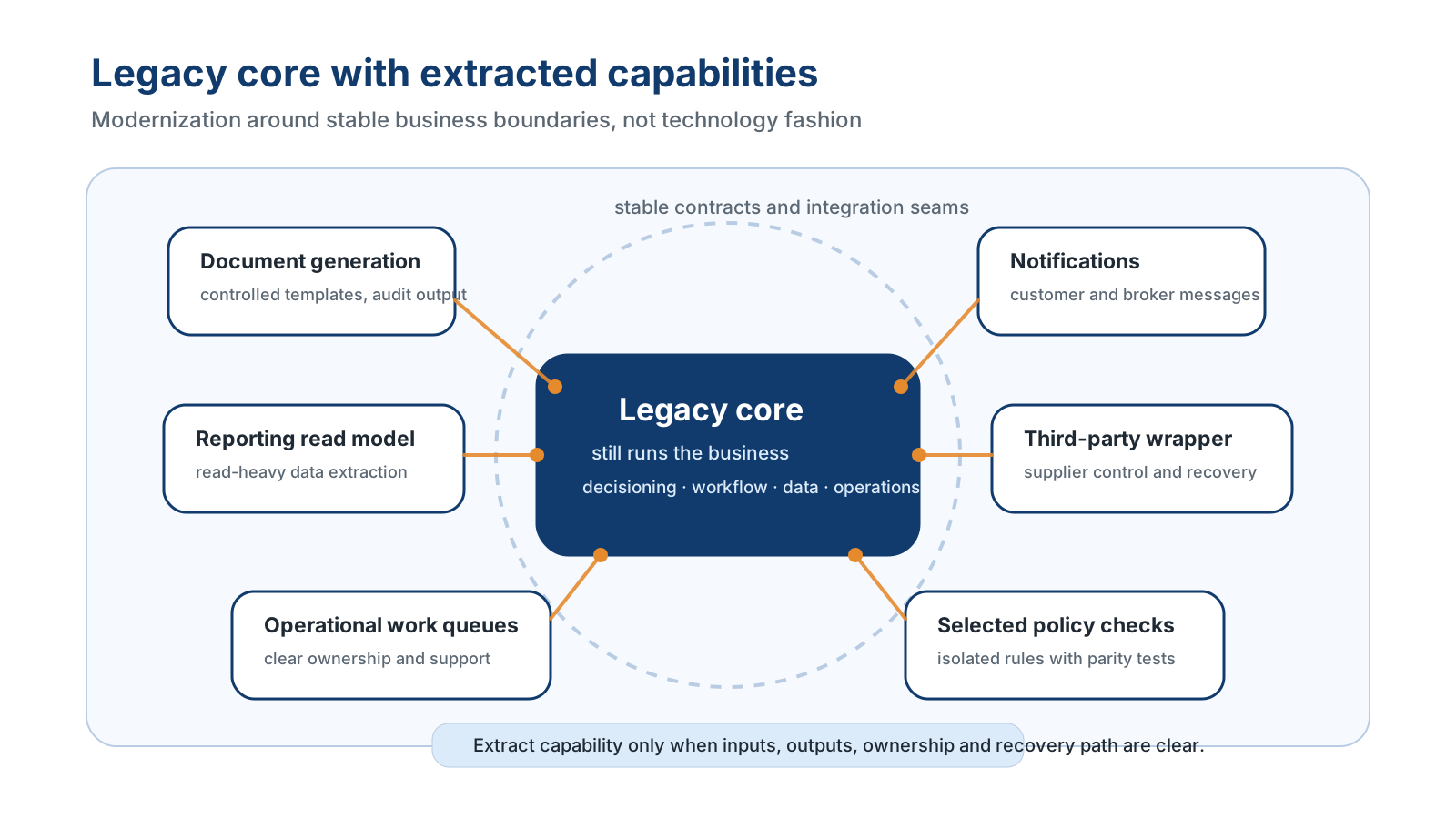
In a financial platform, useful candidate boundaries might include document generation, valuation instruction, credit bureau orchestration, customer notifications, broker communications, case packaging, operational work queues, reporting extraction, KYC orchestration, payment status updates or selected policy checks.
Some are good early candidates. Some need preparation. Some should be left alone until the organisation has better observability, stronger tests, clearer rule ownership or a credible recovery path.
The important point is to avoid decomposing the system around technical layers alone. Extracting the API layer, rules layer or data access layer may make the technology look cleaner while preserving the same business coupling. The real dependency may sit in product behaviour, data ownership, exception handling or operational process.
A useful architecture boundary allows a business capability to change with less impact on the rest of the platform.
That is different from simply creating more services.
Choose the first move carefully
The first modernization candidate should prove the approach without putting the most sensitive part of the platform at unnecessary risk.
A good early candidate usually has a visible business benefit, a manageable failure mode, a clear owner, understandable inputs and outputs, and a practical way to compare old and new behaviour. Reporting extraction, operational dashboards, document generation, notification capabilities, third-party wrappers, operational work queues or selected policy checks often fit that profile.
These areas are not trivial. They still need proper engineering discipline. Their advantage is that they often allow the organisation to create a seam, learn how the platform behaves and demonstrate value without immediately moving ledger-impacting, decision-critical or deeply coupled core logic.
The first move should answer several questions.
Can the team observe how the current behaviour works? Can outputs be compared? Can differences be explained? Is there a recovery route? Does the business owner understand the risk? Are downstream consumers known? Can the old path be retired if the new one succeeds?
If the answer is unclear, the first step may be stabilisation rather than extraction. Add diagnostics. Capture correlation identifiers. Document provider behaviour. Build parity tests. Create a reconciliation report. Remove duplicated or unused paths. A month of disciplined preparation can prevent a year of confused coexistence.
Practical patterns for controlled modernization
No single pattern solves legacy modernization. In critical financial platforms, patterns should be selected for the risk being managed.
The following patterns are useful when they are applied with discipline.
Strangler fig: gradual capability displacement
The strangler fig pattern is useful when selected flows can be routed to a new implementation while the legacy system continues to serve the rest.
In practice, this usually requires a controlled seam: a façade, proxy, gateway, routing rule or integration boundary that can direct traffic to either the old or the new path. The team then moves functionality gradually, proves behaviour and removes the old path when the replacement has earned ownership.
This can work well for document generation, notification services, reporting exports, third-party integration wrappers or specific workflow steps. It becomes harder where the capability shares mutable data, participates in complex transactions or depends on undocumented side effects inside the core platform.
The strangler approach reduces cutover risk when the organisation knows what is being routed, how differences are monitored, how rollback works and when the legacy path will be retired. Used without that discipline, it creates a hybrid estate that is harder to reason about than the monolith it was meant to replace.
Facade or wrapper around a legacy capability
A facade can provide a stable contract in front of an unstable or poorly understood legacy capability.
This is often a good first step before extraction. A platform may have several ways to request a valuation, run a credit check, generate a document or send a customer notification. A wrapper can standardise the external contract while the internal implementation remains unchanged for now.
The value is control. The wrapper gives the organisation a place to add validation, logging, monitoring, correlation identifiers, retry policy, operational diagnostics and provider-specific error handling. It also reduces direct dependency on legacy interfaces.
The recovery model has to fit the capability. Some flows can be controlled with feature flags or traffic routing. Others require replay procedures, manual fallback, compensation logic or an operational runbook. Payments, customer communications, document generation and external provider calls do not all rollback in the same way.
A wrapper should either protect a necessary legacy capability or prepare it for later extraction. A permanent wrapper with no ownership, no simplification and no retirement plan simply hides disorder behind a cleaner interface.
Anti-corruption layer
An anti-corruption layer protects a new or cleaner domain from legacy models, terminology, protocols and behaviours.
This matters in financial platforms because legacy semantics tend to leak everywhere. A new decision orchestration component, case management capability or servicing workflow should not be forced to inherit every historical field name, status value, workflow code and exception flag from the old system.
Translation is still necessary. The new component may need to understand legacy identifiers, product codes, account states, provider references and audit records. The anti-corruption layer gives that translation an explicit home instead of spreading it through the new domain.
The layer becomes part of the production surface. It needs monitoring, versioning, error handling, latency awareness, scalability and clear ownership. It must also preserve auditability: new event identifiers, correlation IDs and decision references need to map back to legacy transaction logs and operational evidence during transition.
This pattern is powerful when it protects the integrity of the new model. It becomes expensive when every legacy inconsistency is simply reimplemented in another place.
Branch by abstraction
Branch by abstraction is useful when a large internal change has to happen gradually while normal releases continue.
The team introduces an abstraction around a capability, moves callers gradually, improves test coverage around the boundary and then changes the implementation behind that boundary. It is less visible than a new service, but often more practical inside a mature platform.
This approach can work for replacing a pricing component, document generator, rules evaluator, integration client or persistence mechanism. It supports steady delivery without long-lived code divergence.
The quality of the abstraction matters. A poor abstraction reproduces the legacy shape with a new name. A useful abstraction reflects the business capability and gives the team a controlled route to replacement.
Incremental data migration and read-heavy extraction
Data is usually the hardest part of financial platform modernization.
A system can look modular at the service level while remaining coupled through shared tables, reporting databases, batch exports, operational spreadsheets, reconciliation processes and downstream consumers.
Read-heavy capabilities are often safer early candidates. Reporting extraction, operational dashboards, audit views, management information feeds or read-only customer summaries can sometimes move before transactional ownership changes. These moves can reduce load on the core, improve transparency and expose hidden data quality issues before more sensitive migration begins.
The distinction between read model and source of truth has to stay clear. A reporting store, projection or dashboard should not accidentally become an unofficial operational system of record. Freshness, replication delay, back-book data, correction flows and downstream consumers need explicit treatment.
Dual-running data paths also need an exit plan. Temporary feeds, shadow tables and reconciliation scripts are useful during transition. They become a liability when nobody owns them after cutover.
Parallel run with reconciliation
Sensitive capabilities often need a parallel run before ownership moves.
A new component can process the same input as the legacy system, compare outputs, measure differences and build confidence before it becomes the path of record. This is especially relevant for decisioning, pricing, eligibility, fees, payment calculations, arrears classification, statement generation or regulatory reporting outputs.
Parallel run is an operational confidence mechanism, not only a testing technique. It needs production-like data, difference reporting, business review, tolerance rules and clear ownership of discrepancies.
In interest-bearing, ledger-related or decision-critical environments, “almost the same” may still be wrong. Legacy systems often contain undocumented rounding behaviour, historic product exceptions or provider-specific mapping logic. Reconciliation has to expose those differences early enough for the business to decide whether they are defects, expected differences or unclear rules that need ownership.
Event interception and integration seam improvement
Sometimes the safest first move is observation.
Event interception can allow a new component to observe business events without taking responsibility for the full legacy flow. Integration seam improvement can give the organisation better control over third-party calls, message formats, retries, monitoring and support evidence.
This is valuable in integration-heavy financial estates. Before extracting a capability, the team may need to understand which requests are sent, which responses are stored, which failures are retried, which exceptions are manually resolved and which data is later used for audit, reporting or customer communication.
Event-driven designs need careful handling. Duplicate events, ordering assumptions, replay, poison messages, idempotency and audit correlation are not details to defer. A new read model can usually tolerate different risks from a payment instruction, a customer notification or a credit decision.
The first event-based step should usually be low-risk observation, audit enrichment or read-model construction. Ownership of state-changing behaviour should move only when delivery semantics, reconciliation and recovery are understood.
Retirement of unused or duplicated functionality
Modernization also means removing what no longer needs to exist.
Mature platforms contain duplicated rules, obsolete product variations, old integration paths, unused reports, historic workflow branches and manual workarounds that were introduced for valid reasons and never removed.
Retirement is commercially valuable because it reduces the surface area of future change. It improves testability, supportability and onboarding. It also makes the remaining platform easier to understand.
Retirement has to be evidence-based. Apparently unused functionality may support a rare operational exception, an old portfolio, a remediation process or a reporting obligation. Before removing it, teams need usage evidence, business sign-off, recovery options and production monitoring.
What should not be modernized first
A controlled programme needs the confidence to say, "not first".
The most strategically important capability is not always the right first candidate. The most painful area is not always the safest first move. The most outdated component is not always the best place to start.
High-risk early candidates usually have several warning signs: unclear ownership, weak test coverage, shared mutable data, undocumented side effects, poor observability, uncertain reconciliation paths, provider behaviour that cannot be simulated, or operational processes that depend on a small number of experienced people.
That does not mean these areas should never be modernized. It means they need preparation.
The most complex decisioning engine, heavily coupled pricing logic, payment processing, arrears logic, servicing calculations or ledger-related functionality should usually wait until the organisation has better diagnostics, stronger automated tests, clear rule ownership, parallel-run capability, reconciliation reporting and a credible recovery route.
A senior architecture team should be able to say: "Not first." Responsible sequencing is not resistance to change. It is the discipline that prevents modernization from becoming another source of production risk.
Balancing modernization with business-as-usual delivery
Modernization often fails when it silently competes with business-as-usual delivery until both suffer.
Financial platforms continue to need product changes, client onboarding, incident fixes, regulatory updates, operational improvements and provider changes while modernization is underway. Spare capacity is rarely enough. Using the same people for urgent delivery and deep platform change without clear prioritisation creates delay, frustration and poor technical decisions.
A credible plan needs dedicated capacity, even if the team is small. It also needs architecture guardrails that help delivery teams make local decisions without reopening the whole strategy every week.
Small releases matter because they reduce risk and create feedback. They only help when they belong to a coherent sequence. Random local improvements can still create strategic drift.
Leadership needs visibility of the risk being reduced, not only the work being delivered. Which platform risks are lower this quarter? Which are being accepted? Which have increased because of temporary coexistence? Which transitional components have an owner and retirement date? Which third-party dependencies remain difficult to control? Which manual operations still protect the process?
Useful governance works like an engineering safety mechanism. It defines the rules that keep delivery moving in the right direction. Examples might include: no new direct dependency on legacy tables from extracted services; every third-party call must have correlation IDs and operational diagnostics; every parallel-run capability must have a reconciliation report; every temporary adapter must have an owner and retirement trigger.
The funding conversation should follow the same logic. A programme that cannot show business-facing progress will lose confidence. A programme that delivers visible features while ignoring platform risk will modernize very little. The best plans connect platform work to outcomes: faster product change, safer integrations, lower support risk, better auditability, improved recovery options, more reliable reporting and fewer releases that depend on undocumented knowledge of the core.
The role of architecture
Architecture in this context is the practical discipline of deciding how the system can change safely.
Good architecture defines capability boundaries, integration contracts, data ownership, sequencing, operational controls, failure modes, recovery paths, observability, decision records and retirement plans. It also identifies the parts of the estate that should deliberately remain stable for now.
That last point is important. Under pressure, architecture is often expected to produce a target-state diagram that makes everything look cleaner. A useful modernization architecture also describes the transition. It shows how the organisation gets from current state to target state without losing control of production.
That means answering uncomfortable questions early.
How will old and new components coexist? Where will data be mastered? How will discrepancies be reconciled? Who supports the new component out of hours? What happens when a provider is unavailable? Which logs prove what happened? How is rollback or recovery handled? Which manual process remains during transition? Which old capability can be retired, and when?
These are architecture questions. They are also delivery questions, operational questions and risk questions.
In critical financial platforms, architecture has to stay close enough to delivery to understand real constraints and far enough above the immediate backlog to protect the direction of travel. That balance is where senior judgement matters.
The role of AI-assisted work
AI-assisted work can increase the pace of modernization when it is used by experienced engineers who understand the platform, the business context and the consequences of getting the analysis wrong.
In legacy financial systems, a large amount of knowledge is hidden in places that are difficult to review manually: stored procedures, workflow definitions, configuration tables, mapping layers, integration clients, report queries, product rules, old scripts and exception-handling paths. AI can help engineers move through that material faster. It can summarise code paths, group related behaviour, identify repeated patterns, compare implementations, prepare review checklists, suggest test scenarios and highlight areas that deserve closer human inspection.
That acceleration is valuable during early discovery. Teams can use AI to build a first map of the system: which components call a given integration, which tables are touched by a process, which rules influence a pricing decision, which workflows generate documents, which batch jobs update operational status, and which parts of the estate appear to duplicate similar behaviour. This gives architects and engineers a better starting point for investigation.
The important discipline is validation. Legacy code often contains business behaviour that is easy to misread. A stored procedure may encode a historical product rule. A workflow condition may protect a remediation case. A configuration flag may exist because a provider once behaved differently in production. A strange mapping may support an old portfolio, a regulatory report, a manual workaround or a customer communication that only appears during exceptions.
AI-generated analysis should therefore be treated as a route into the system, rather than the final answer about the system. Engineers still need to verify important findings through tests, code review, production evidence, logs, data samples, operational walkthroughs and conversations with people who have supported the platform over time.
This is especially important when modernization decisions affect financial outcomes. Pricing, affordability, credit decisioning, payments, arrears, fees, interest calculations, document generation and regulatory reporting all need behavioural evidence before responsibility moves from an old component to a new one. In those areas, a useful AI summary can speed up investigation, but confidence has to come from repeatable tests, reconciliation results and business review.
AI can also help with test planning. When a team is preparing to wrap, replace or parallel-run a capability, AI can suggest edge cases, identify missing scenarios, compare old and new outputs, and help structure regression packs around real business behaviour. That can be particularly useful when the existing test suite is weak or when much of the expected behaviour exists only in production data and operational knowledge.
The best use of AI in this context is practical and controlled. It helps senior engineers explore faster, ask better questions, prepare stronger test coverage and challenge assumptions earlier. The architectural judgement remains with the team. They decide which capability is safe to extract, which dependency needs a wrapper, which data flow needs reconciliation, which output difference matters, and which part of the platform should stay stable for now.
Used in that way, AI becomes part of the modernization toolkit. It improves the speed and quality of analysis while keeping accountability with the engineers and architects responsible for production change.
Signs that modernization is working
Modernization is working when the organisation becomes better at changing safely.
That is broader than launching new components.
Useful signs include:
- fewer changes requiring risky modification inside the core platform
- integrations that are easier to add, replace, monitor and support
- defects that are easier to isolate
- operational incidents that are easier to diagnose
- clearer data flows and source-of-truth ownership
- reconciliation reports that are explicit and reviewed
- third-party dependency risk that is visible enough to manage
- extracted capabilities with clear owners, support models and recovery paths
- temporary wrappers and adapters being retired rather than accumulating
- release confidence improving because behaviour is better understood
- business stakeholders seeing value before the whole programme is complete
The most useful measures are practical. How many releases avoided core modification? How long does it take to diagnose an integration failure? How many legacy paths were retired? How many reconciliation exceptions remain unexplained? How many critical provider calls have useful operational evidence?
These indicators show whether modernization is reducing execution risk. Technology change is only valuable when it improves the organisation’s ability to change the business safely.
A controlled path forward
A full rewrite can sometimes be justified. There are systems where the cost, risk or strategic misalignment of the current platform becomes too high to continue.
For most live financial platforms, the harder question is execution. Can the organisation replace or reshape the platform without creating unacceptable business, operational, data or customer risk?
The safer path is often incremental.
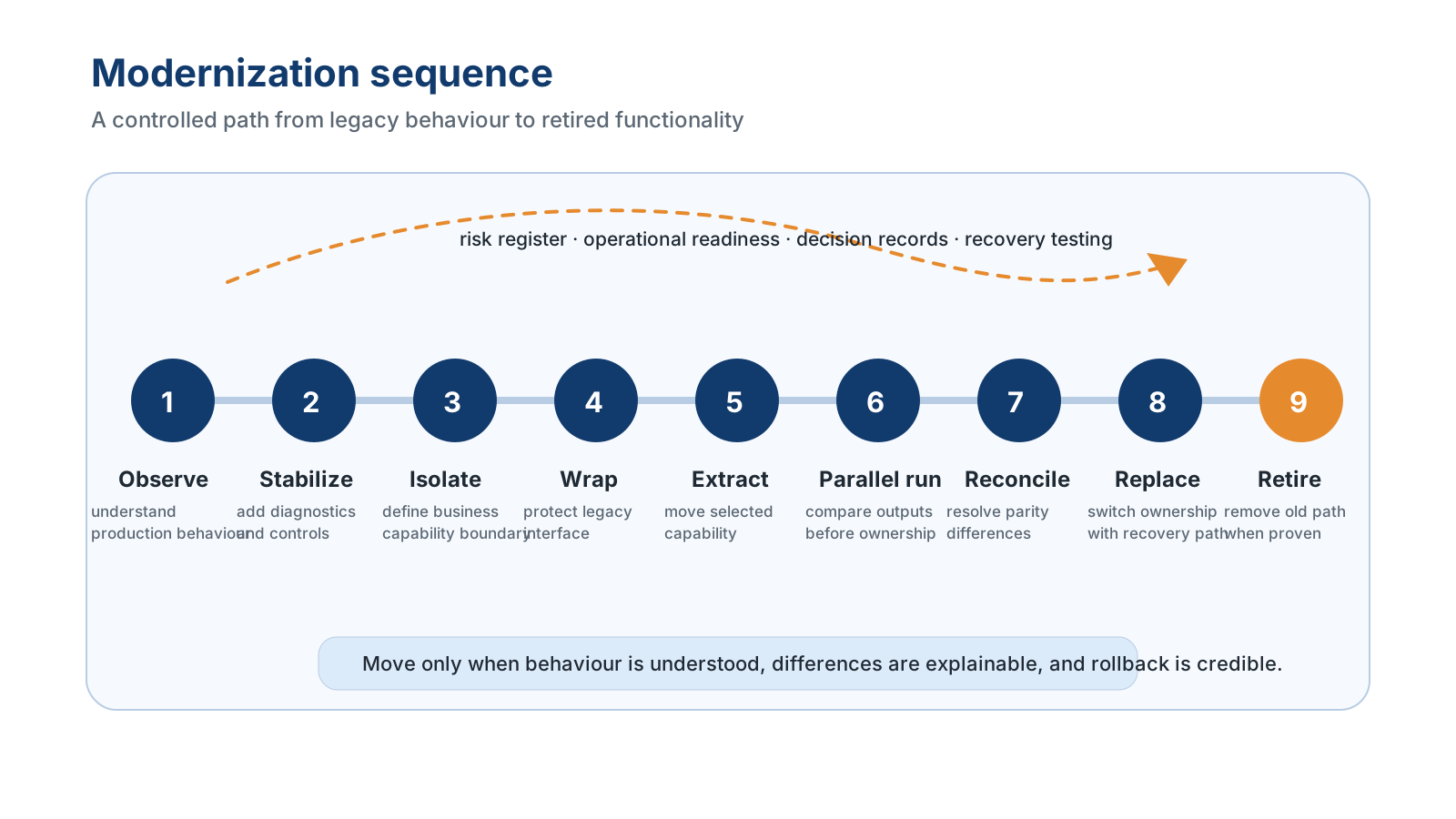
Understand the current behaviour. Identify capability boundaries. Improve observability. Create seams. Wrap unstable interfaces. Extract selected capabilities. Run in parallel where needed. Reconcile differences. Move ownership only when the evidence is strong enough. Retire old functionality when the replacement has proven itself. Keep business-as-usual delivery moving throughout.
This is less dramatic than a full rewrite. It is also more honest about how complex financial platforms actually change.
At Quercore Systems, this is the modernization we believe in: controlled, architecture-led and delivery-aware. The aim is not to chase technology fashion, sell compliance or present AI as a shortcut. The aim is to help critical financial platforms change safely, with senior technical judgement, production-aware engineering and a realistic understanding of the operating environment.
The outcome is not only a cleaner architecture diagram. The outcome is a platform the organisation can change with more confidence, clearer ownership, better recovery options and less dependence on undocumented legacy behaviour.
That is what modernization needs to achieve when the system still runs the business.
Sources
- Martin Fowler, "Strangler Fig Application"
- Martin Fowler, "Patterns of Legacy Displacement"
- Martin Fowler, "Branch by Abstraction"
- Microsoft Architecture Center, "Strangler Fig pattern"
- Microsoft Architecture Center, "Anti-corruption Layer pattern"
- Microsoft Architecture Center, "Event-driven architecture style"
- AWS Prescriptive Guidance, "Strangler fig pattern"
- Thoughtworks, "Fitness function-driven development"
- European Banking Authority, "Digital Operational Resilience Act"
- EIOPA, "Digital Operational Resilience Act (DORA)"
- Financial Stability Board, "Enhancing Third-party Risk Management and Oversight"
- Basel Committee on Banking Supervision, "Principles for operational resilience"
- NIST, "AI Risk Management Framework"
- OWASP, "Top 10 for Large Language Model Applications"